

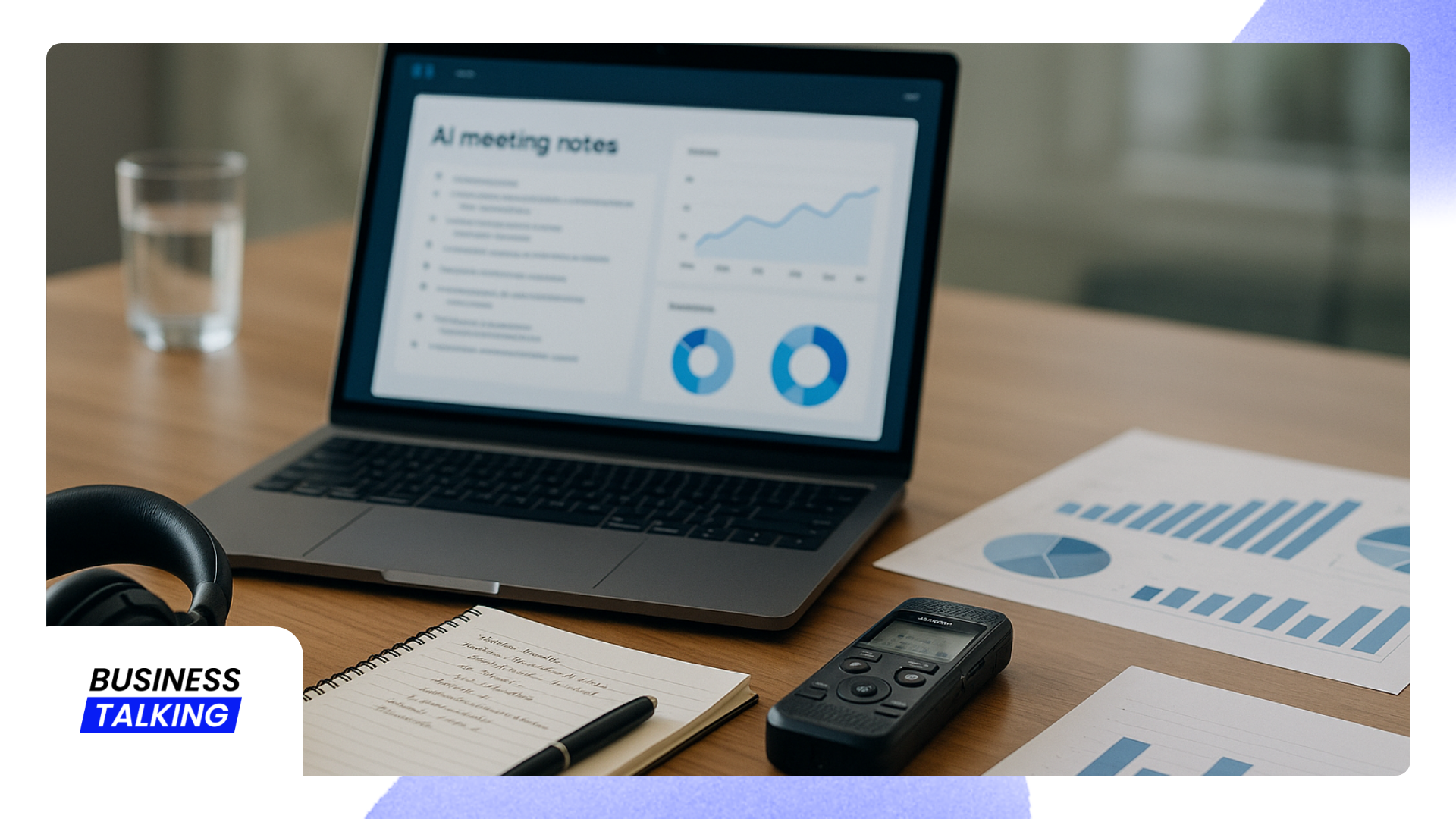

Most meeting notes are either late, incomplete, or written by the one person who was meant to be listening. Sales calls are worse, because the stakes are higher and memories get selective. That’s why teams keep searching for something that can capture the detail without turning every call into admin. This is an analysis of AI note-taking tools compared in practical terms: what matters, what breaks, and where the hidden costs sit.
Done well, automated notes reduce rework and make decisions traceable. Done badly, they create a false record that people trust too much. The difference is rarely the brand name, it’s the way the tool is configured, governed, and used.
In this article, we’re going to discuss how to:
- Choose between meeting-first and sales-first note-taking tools
- Judge accuracy, governance and integration risk before rollout
- Set up workflows that produce usable notes, not noise
What You’re Actually Buying With Meeting And Call Notes
Most tools in this space bundle 4 separate jobs: recording, transcription, speaker labelling, and summarisation. Recording is a product and policy question. Transcription is an accuracy question. Speaker labelling is a trust question. Summarisation is a judgement question.
When people say they want ‘notes’, they usually mean 3 outputs:
- A reliable record of what was said, with timestamps.
- A decision log: what was agreed, who owns it, and by when.
- A follow-up pack for the next interaction, especially in sales.
It’s worth separating those needs upfront, because a tool that’s fine for internal meetings can be risky for customer calls, and vice versa.
AI Note-Taking Tools Compared: The Decision Criteria That Matter
If you’re doing AI note-taking tools compared by feature checklists alone, you’ll miss the real failure points. Use criteria that map to operational risk.
1) Consent, Recording Controls And Retention
Before you compare note quality, confirm what your organisation is allowed to record, and how consent is handled. In the UK, this quickly becomes a governance issue, not a tooling issue. The Information Commissioner’s Office is a sensible starting point for thinking about transparency and lawful processing: ICO UK GDPR guidance.
Look for practical controls: whether the host can disable recording, whether participants are notified, and how long audio, transcripts and summaries are kept. Also check whether you can delete individual meetings, and whether deletions propagate to backups within a stated period.
2) Accuracy Under Real Conditions
Demo accuracy is not the same as real accuracy. Accents, crosstalk, poor microphones, industry jargon, and people talking over Zoom speakers all push error rates up. The risk is not just missed words, it’s wrong words, because wrong words look confident on a page.
In procurement terms, ask to test with your own recordings, under your normal conditions, and judge results against tasks, not vanity metrics. Can you trust action items? Can you trust who said what? Can you search the transcript and find the right moment quickly?
3) Speaker Labelling And Attribution
Speaker labelling errors are a quiet problem. In a sales call, attributing a promise to the wrong person can cause follow-up mistakes. In internal meetings, it can create unnecessary politics. Treat diarisation as a first-class requirement, especially if you plan to share notes widely.
4) Integration Surface Area
Tools differ most in where they live. Some sit inside your meeting platform. Others join as a bot participant. Some focus on exporting notes into your CRM or ticketing system. Every integration adds permissions, tokens, and a new place for sensitive data to travel.
As a minimum, check whether the tool supports the calendars and meeting platforms you actually use, and what it needs in terms of access. If the tool requests broad mailbox or drive access, treat that as a serious design decision, not a tick-box.
5) Notes That Are Usable, Not Just ‘Nice’
Pretty summaries can be useless if they don’t match your way of working. For meetings, you want decisions and owners. For sales, you want objections, next steps, stakeholders, and anything that changes deal risk. If the tool can’t be guided towards the structure you need, you’ll still end up rewriting.
Meeting-First Tools Vs Sales-First Tools
There’s a real split between tools designed for general meetings and those designed for revenue teams. Meeting-first tools typically focus on personal productivity: transcripts, highlights, and shareable summaries. Sales-first tools tend to include conversation analytics, libraries of calls, and CRM workflows.
Neither category is ‘better’. The trade-off is what they assume about your governance and your reporting needs. Sales-first setups often require more admin, more standardisation, and tighter permissions because the call library becomes a company asset.
Comparison Summary Table (Practical View)
This table is deliberately conservative. Product features change often, and what matters is fit for your constraints. Treat this as a starting frame for evaluation, not a promise of capability.
| Tool (examples) | Best Fit | Strengths In Practice | Common Limitations To Check | Pricing Approach (avoid assumptions) |
|---|---|---|---|---|
| Otter | General meetings, personal notes | Fast capture and searchable transcripts | Consent controls, speaker labelling quality, export formats | Subscription tiers, verify current plans on vendor site |
| Fireflies | Cross-team call libraries | Central repository of calls and notes | Bot behaviour in meetings, permissions model, data retention options | Subscription tiers, verify current plans on vendor site |
| Fathom | Teams wanting simple meeting summaries | Quick summaries and highlights for internal calls | Coverage across meeting platforms, admin controls, sharing boundaries | Plan-based pricing, verify current plans on vendor site |
| tl;dv | Reviewing meetings asynchronously | Timestamped notes and clips for review | Recording permissions, how clips are stored, access controls | Plan-based pricing, verify current plans on vendor site |
| Gong / Chorus (revenue platforms) | Sales teams with defined process and CRM hygiene | Sales workflows, coaching libraries, CRM context | Implementation effort, governance burden, change management | Typically contract-based, confirm directly with vendor |
| Meeting platform features (Microsoft Teams, Zoom, Google Meet) | Organisations that want fewer vendors | Native controls, identity and access aligned to existing accounts | Summary quality varies, export options, cross-platform gaps | Often bundled or add-on, check your licence terms |
Operational Risks People Underestimate
Confident Summaries Create False Certainty
A fluent summary can hide uncertainty. If the underlying transcript is wrong, the summary will be wrong in a more convincing way. This is why governance matters: decide when notes are advisory versus when they become the record.
Sharing Defaults Create Accidental Oversharing
Many tools make sharing easy, which is great until confidential calls get shared more widely than intended. Check default sharing settings, whether links are public to anyone with the URL, and whether access is tied to your identity provider.
Retention Becomes A Discovery Problem
Keeping every call forever feels useful, until you have a legal hold, a subject access request, or a customer dispute that forces you to search what you hold and why. The UK GDPR principle of storage limitation is a useful lens even if you are not a compliance specialist: ICO storage limitation overview.
A Practical Evaluation Method (Without Overthinking It)
You can get to a sensible choice quickly if you test the right things and avoid theatre.
- Run a 2-week pilot on real internal meetings and a small set of customer calls where consent is clear.
- Score outputs against tasks: correct action items, correct owners, correct numbers, and whether the summary matches what the team agreed.
- Map data flows: where audio lives, who can access it, and how deletion works.
- Check admin surfaces: user provisioning, audit logs, and role-based permissions if available.
- Test exports: can you move notes into your CRM, ticketing tool, or document store without copying and pasting.
Don’t let the pilot become a referendum on whether people like reading notes. Your question is whether the tool reduces follow-up work and improves recall without adding new risk.
Workflows That Make Notes Worth Reading
Tools can produce pages of text. The goal is a short artefact that someone can act on.
For Internal Meetings
Use a standard structure: decisions, action items, open questions, and risks. If the tool supports custom templates or prompts, keep them short and specific to your meeting types. If it does not, treat the tool as a transcript provider and create a human-edited decision log.
For Sales Calls
Focus on what changes the deal: customer goals, constraints, objections, stakeholders, timing, and next steps. Treat summaries as a draft that the account owner is responsible for correcting, especially around numbers, dates and commitments.
Conclusion
AI notes are useful when they reduce rework and make decisions easier to revisit, not when they create another system people don’t trust. The best tool is usually the one that fits your consent model, identity setup, and retention rules with the least compromise. If you run a short pilot on real calls, you’ll spot the gaps faster than any feature list will show.
Key Takeaways
- Compare tools on consent, retention and access controls before you compare summary quality
- Test accuracy on your recordings, and judge results against action items and attribution
- Keep notes structured around decisions and next steps, otherwise you’ll still rewrite them
FAQs For AI Note-Taking Tools Compared
Do AI note-taking tools work well with strong accents and noisy calls?
They can, but performance varies a lot depending on audio quality, overlap in speech, and domain jargon. Always test with your own recordings rather than relying on demos.
Is it safe to use these tools for customer calls in the UK?
It can be, but only if consent and transparency are handled properly and retention is controlled. Use the ICO’s guidance as a baseline and involve whoever owns privacy and risk internally.
Should the summary be treated as the official record?
Usually not, especially for decisions with legal or commercial impact. Treat summaries as a draft, and keep access to the underlying transcript and timestamps for verification.
What’s the quickest way to spot a bad tool during a pilot?
If it regularly gets names, numbers, or action owners wrong, trust will collapse quickly. The other early warning is weak admin controls, because governance problems grow over time.
Sources Consulted
- Information Commissioner’s Office (ICO): UK GDPR guidance and resources
- ICO: Storage limitation principle
- GDPR.eu: General Data Protection Regulation (reference text and explanations)
Information Only Disclaimer
This article is for information only and does not constitute legal, compliance, or security advice. Product features and policies change, so validate requirements and controls in your own environment before relying on them.