


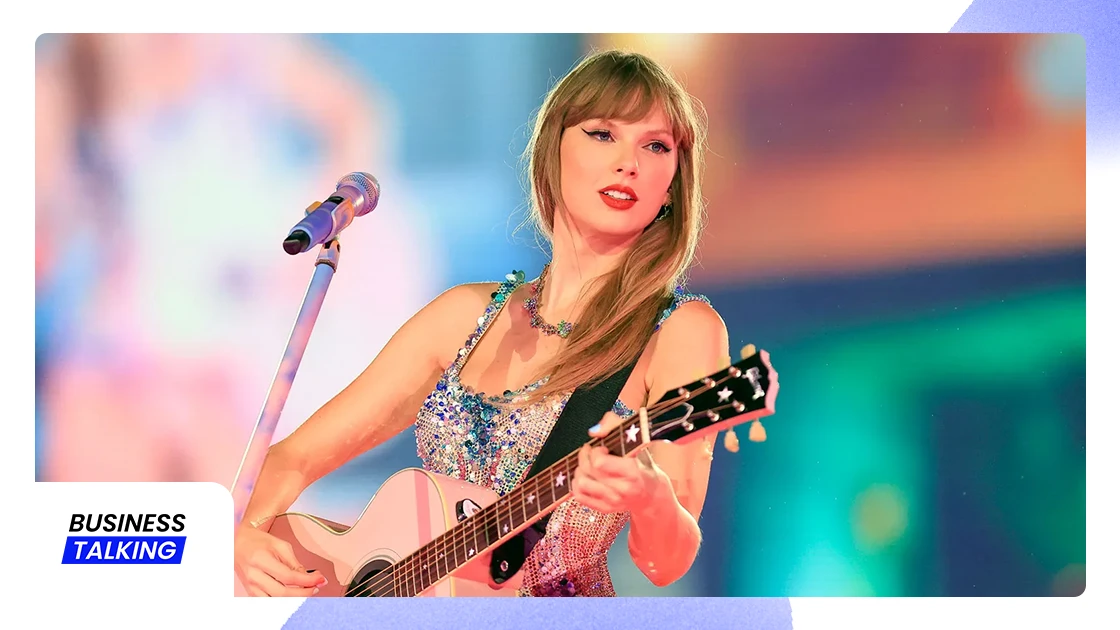

Taylor Swift’s wealth story is not interesting because it is celebrity gossip. It is interesting because it is a clear case study in modern monetisation: distribution, pricing power, ownership, and compounding.
The headline figure often cited for Taylor Swift’s net worth is an estimated $1.6B net worth. That number is not built on one ‘big payday’. It is built on a system where each major release increases demand, demand increases leverage, and leverage is used to secure better economics and greater control.
This article looks at the business model behind the fortune. It focuses on the commercial mechanics that founders, marketers, and operators can recognise, then apply in their own world.
How Swift’s Flywheel Works
Most creators and brands earn in straight lines: launch, spike, fade, repeat. Swift’s model behaves more like a loop.
In practice, attention creates demand. Demand supports premium pricing. Premium pricing improves cashflow. That cashflow funds bigger distribution, stronger partnerships, and greater control over rights. With more control, the next release lands harder, because the audience is already primed and the machine is already moving.
That loop is the story. Everything else is execution detail.
Live Experiences At Historic Scale
If one lever explains the step-change in recent years, it is live performance at industrial scale.
The Eras Tour has been widely reported as the highest-grossing concert tour ever, with an estimated gross of $2.077B across 149 shows. That scale matters because ‘live’ is not just a product, it is a distribution channel. A stadium tour creates a rolling media cycle: press coverage, social clips, cultural conversation, and an ongoing reason for casual fans to pay attention again.
The economics are also not just about selling more tickets. The upside comes from price architecture. When premium options, scarcity, and experience upgrades are designed properly, the value per customer rises, not just the number of customers.
Vertical Integration: One Moment, Multiple Revenue Lines
Many brands treat revenue lines as separate projects. The stronger approach is to treat them as one system, with one demand engine feeding multiple formats.
Touring creates the moment. That moment increases the value of everything around it. Merchandise performs better because demand is peaking and attention is concentrated. Partnerships become more valuable because there is visible proof of reach at scale. Filmed content becomes a natural extension because the live experience is already validated and the audience wants a version they can rewatch and share.
A well-built stack does not feel like random monetisation. It feels like the same product delivered in different forms, built to match different customer behaviours.
Ownership As The Real Wealth Lever
High income is not the same as high net worth. Net worth grows when income is converted into assets that keep paying for years.
For Swift, the most important asset category is music rights. Ownership matters because it controls future cashflow. When rights are owned, licensing, distribution terms, and catalogue exploitation are controlled by the owner, not by intermediaries. That turns creative output into an asset that can compound long after the first release cycle ends.
The broader business lesson is uncomfortable but useful. If growth depends heavily on platforms that are not controlled, distribution is being rented. Renting can work, but it rarely builds durable wealth on its own. Durable wealth tends to be built by owning something defensible, such as proprietary IP, a product ecosystem with switching costs, an owned audience, brand demand, or a network that is hard to replicate.
Negotiation As Strategy, Not Luck
Leverage is not a personality trait, it is a position that is built. The pattern is consistent across successful operators: build demand first, then negotiate from strength.
Swift’s career shows repeated examples of using peak attention to secure better terms. The principle is the same in business. The best time to negotiate is when there are options. When inbound is strong, when retention proves product-market fit, and when walking away is genuinely possible, that is when structural wins are available.
Those wins are not just about more money. They are about permanent advantages: better economics, longer-term control, and fewer dependencies.
An Owned Audience That Actually Converts
Audience is often treated like a vanity metric. In practice, audience means repeat attention plus trust. It is the ability to make something and have people care, without paying a platform every time.
Swift’s model is built on repeat attention engineered through consistency and ritual. Releases feel like events. Formats create collectability. Community identity is reinforced in ways that encourage participation, sharing, and repeat purchasing. That turns attention into predictable conversion.
For businesses, the translation is clear. A reason to return is more valuable than a reason to buy once. In SaaS, that might mean education, templates, community, and a steady drumbeat of momentum. In e-commerce, that might mean drops, bundles, collaborations, and UGC loops that keep products visible between purchases.
Pricing Power Built Through Packaging And Distribution
Pricing power sounds abstract until it is defined properly. It means being able to charge more without killing demand, and being able to sell premium tiers because customers trust the outcome.
Swift’s pricing power is not purely about popularity. It is built through scarcity, status, quality consistency, and distribution dominance during active cycles. The key point is that pricing power is rarely just ‘better product’. It is product plus brand plus distribution, then packaging that makes higher spend feel natural.
For SaaS operators, the parallel is straightforward. Pricing power grows fastest when value is tied to outcomes that matter, proof is visible, and packaging allows customers to pay more as usage or value increases.
Turning Income Into Assets
Many high earners never become wealthy because they do not convert income into assets. Wealth is built by repeatedly taking cashflow and buying things that outlive the cashflow source.
Swift’s model shows the compounding effect of doing this well: creative output becomes monetisable demand, demand becomes cashflow, and cashflow becomes ownership and control. That control increases future earning power, which makes the next cycle larger.
The commercial habit behind this is boring but effective. Strong businesses ask, regularly, what asset is being bought with today’s cashflow. If the answer is nothing, income is being built, not wealth.
The Taylor Swift Blueprint: Seven Lessons Operators Can Steal
This section is worth keeping as a short list because it is the practical ‘so what’.
- Build a flywheel, not a funnel. Funnels end, flywheels compound.
- Create moments that reset demand, such as launches, events, partnerships, and campaigns.
- Stack revenue around the core offer, rather than bolting on random side projects.
- Package for premium so higher spend feels natural for top customers.
- Negotiate at peak leverage, then lock in terms that last.
- Turn attention into assets, such as IP, owned distribution, and brand demand.
- Protect focus, because dilution kills pricing power.
A Note On Net Worth Numbers
Net worth figures are estimates. They are based on publicly reported earnings, major deal information, catalogue valuation logic, and reasonable assumptions. The precise number matters less than the mechanism behind it.
The useful takeaway is not ‘how much’. It is ‘how’.
Read The Full Forensic Breakdown
For readers who want a deeper, numbers-first version with a fuller breakdown of the wealth drivers and supporting detail, the long-form Taylor Swift net worth report can be explored here.