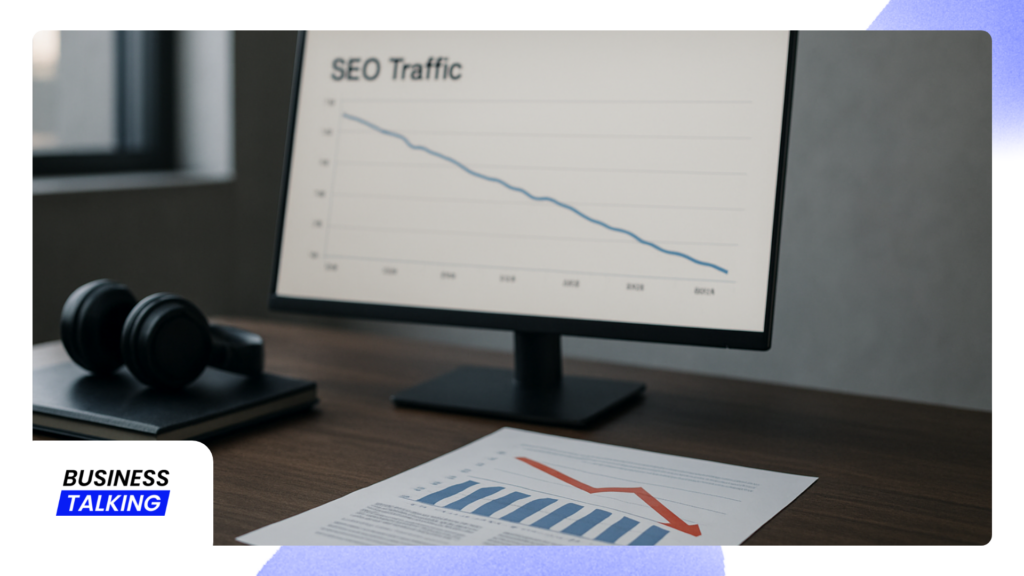


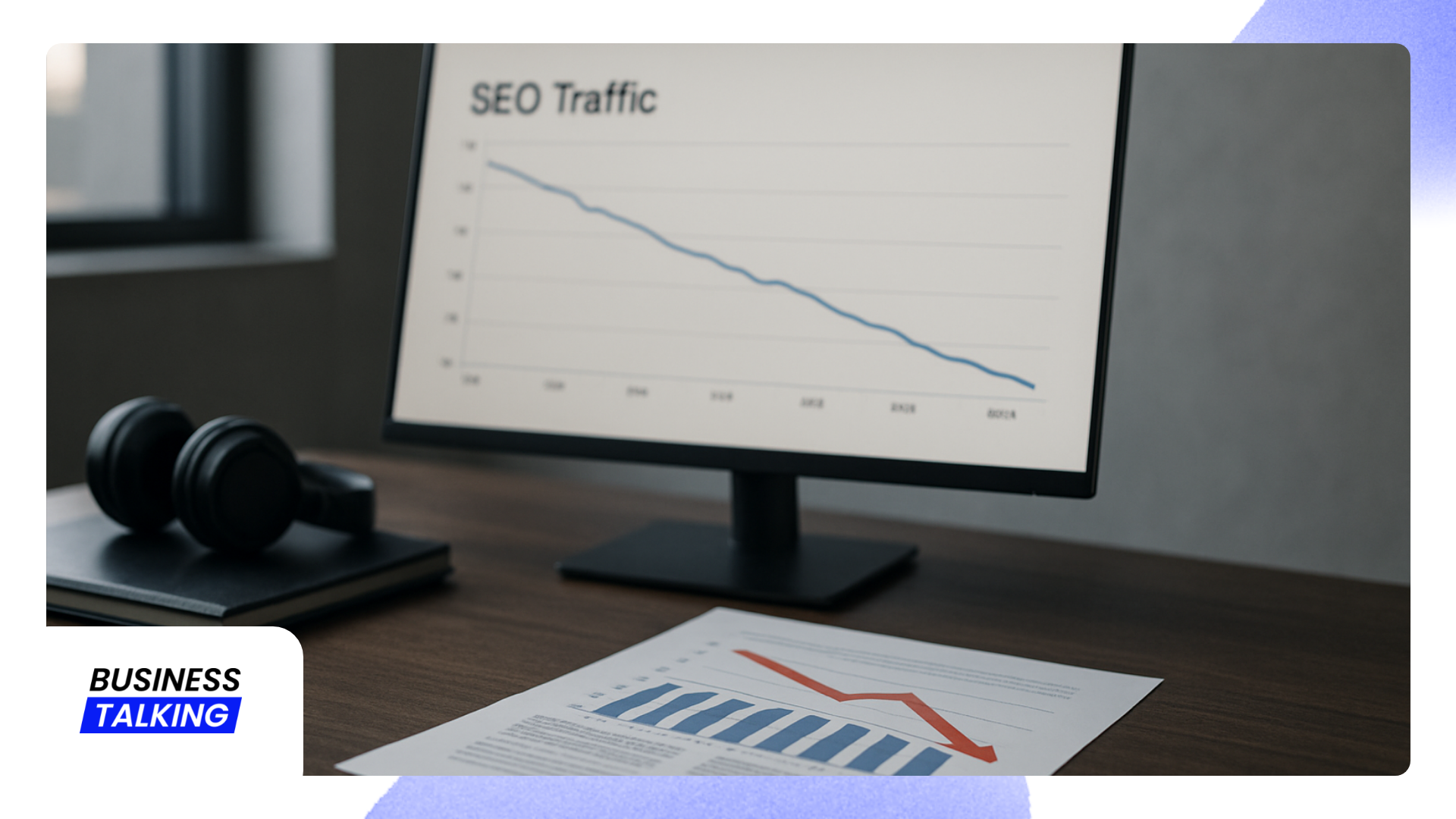

Organic search used to feel like a fortress: rank well, bank the clicks, repeat. That’s not how it’s playing out now, and 2026 will make the shift harder to ignore. Between AI answers, heavier ad real estate and more ‘no-click’ results, even strong rankings can translate into weaker outcomes. The result is a steady SEO traffic decline for many sites, and a lot of teams reacting too late. The question isn’t ‘is SEO dead’, it’s what replaces it as the moat.
‘In this article, we’re going to discuss how to:’
- Spot the real drivers behind organic click loss, not just ranking changes.
- Build alternative moats that don’t rely on one platform sending you free demand.
- Stay visible in AI-led search journeys without chasing every new format.
Why SEO Stops Being A Moat
SEO is still useful, but it’s no longer defensible in the way founders and marketing leads used to think about it. A moat is something competitors can’t quickly copy, and something platforms can’t easily take away. Traditional SEO fails on both counts.
Competitors can copy your content angle in a weekend, especially when search results reward ‘good enough’ pages for broad queries. And platforms can change the rules overnight: a new results layout, a new AI answer box, a new preference for forums or video, then your clicks drop even if your ranking stays.
What’s changing is not just where you rank, it’s whether searchers ever need to click. Google has been explicit for years that it’s working to answer more queries directly on the results page, and AI Overviews push that further. You can read Google’s own framing in its Search Central documentation on results features and how pages appear in search: https://developers.google.com/search/docs.
SEO used to be a ‘traffic moat’ because the click was the default next step. Now, the click is optional, and for plenty of informational queries it’s becoming the exception.
SEO Traffic Decline: What’s Actually Driving It
When people talk about SEO traffic decline, they often assume it’s because ‘Google penalised us’ or ‘our content got worse’. Sometimes that’s true, but in 2026 it will more often be structural.
Here are the patterns that matter:
- More answers without clicks: featured snippets, knowledge panels, local packs and AI summaries reduce the need to visit a site.
- More competing surfaces: shopping modules, maps, video and forum results can push standard web listings down the page.
- Intent drift: searchers are moving parts of research behaviour to TikTok, Reddit and AI chat tools, then only using Google to validate.
If you want to diagnose your own situation, separate three things: visibility (impressions), attractiveness (click-through rate) and usefulness after the click (conversion and retention). Many sites are seeing impressions hold up while clicks fall, which suggests the problem is not ‘being found’, it’s ‘being chosen’ and ‘being needed’.
Also, watch branded versus non-branded queries. Brand demand can rise while generic demand gets squeezed by SERP features, which can hide the true story if you only look at total organic sessions.
The Replacement Moats: What Works When Free Clicks Shrink
If SEO isn’t a moat, what is? In practice, the moats that hold up in 2026 share one trait: they create demand or access that isn’t granted at the whim of one platform.
1) Brand Demand You Don’t Have To Rent
Branded search is still one of the few areas where you can’t easily be ‘feature-boxed’ out of your own demand. People searching your name are more likely to click, and less likely to be satisfied by a generic summary.
Brand demand isn’t built with slogans. It’s built by consistent proof: clear positioning, repeatable outcomes, and enough public examples that people remember you when they hit the ‘I need this solved’ moment. Think case studies with specifics, candid pricing ranges, and honest trade-offs. If your marketing avoids specifics, you’re making it easier for AI summaries to replace you.
2) Proprietary Audience And Repeat Visits
A real moat is a relationship you can reach again without paying for it each time. That can be an email list, a community, or a product experience that creates return visits. This is not about pumping out ‘content’ for its own sake, it’s about building a habit loop: people come back because it saves them time or reduces risk.
From a defensive angle, it also reduces the impact of algorithm changes. If half your pipeline comes from one traffic source, you’re not running marketing, you’re running a dependency.
3) Proof Assets That Are Hard To Copy
Generic blog posts are easy to replicate. Original proof is harder. The most defensible content assets in 2026 look like this:
- First-party benchmarks based on your own customer base, clearly described.
- Before-and-after examples with constraints, budget and timeframe stated.
- Templates, calculators or checklists that reflect your actual process, not a generic one.
These assets do double duty. Humans trust them more, and AI systems have more concrete material to cite, summarise and attribute.
4) Distribution You Can Control And Measure
Most firms under-invest in distribution because SEO used to cover the top of the funnel. In 2026, the firms that win will treat distribution as a product: a repeatable system across channels where you can test messages, learn quickly and compound reach.
That might include partnerships, events, founder-led content, PR, podcasts, or paid social used with restraint. The point is to build multiple routes to the same outcome, so one platform change doesn’t wipe out a quarter’s targets.
Visibility In AI Search: Aim To Be Cited, Not Just Ranked
AI-led search experiences are not purely about ordering 10 blue links. They’re about synthesis, summarisation and citation. Your goal shifts from ‘be position 1’ to ‘be a source worth quoting’.
To get there, focus on ‘extractable clarity’. That means writing and structuring pages so a system can safely take a snippet without losing meaning:
- Define terms once, plainly: if you use jargon, define it in the same paragraph.
- Use claims with boundaries: avoid absolute statements, give context like sector, company size or timeframe.
- Back key points with sources: link to primary references where appropriate, for example the UK ICO guidance on cookies and tracking: https://ico.org.uk/for-organisations/guide-to-pecr/cookies-and-similar-technologies/.
Also, treat ‘entity clarity’ as a baseline. Be unambiguous about who you are, what you do, where you operate and what makes you different. That’s not a trick, it’s making it easier for systems and people to categorise you correctly.
Stop Treating Clicks As The Only Win
If you’re judging SEO only by sessions, you’ll miss what’s happening. In a world of no-click answers, a brand can gain influence while losing traffic. That’s uncomfortable, but it’s real.
The practical fix is to widen measurement without pretending attribution is perfect. Track:
- Branded search trend: it’s a proxy for mental availability, even if it’s not a clean conversion path.
- Share of impressions for priority topics: Search Console is still useful for this, even when clicks soften.
- Down-funnel outcomes: qualified leads, sales conversations, repeat purchases, retention.
Where possible, use experiments. For example, hold back spend or publishing in one segment and compare outcomes. It won’t be neat, but it’s better than arguing over last-click reports that were shaky even before AI summaries.
The Risks In The ‘Post-SEO Moat’ Plan
Replacing an SEO-led strategy with ‘brand’ can become an excuse for vague work. If you can’t write down what will change in 90 days, you’re probably buying theatre. Similarly, chasing every new AI format can turn into busywork that never compounds.
There are also governance risks. More tracking to compensate for weaker click signals runs into consent, cookie rules and data minimisation expectations. If you’re operating in the UK or EU, the fundamentals still apply and enforcement hasn’t gone away, see the ICO’s resources: https://ico.org.uk/.
Finally, distribution diversity has a cost. More channels means more creative, more operational overhead and more ways to get messaging wrong. The trade is worth it, but only if you keep the strategy tight.
Conclusion
SEO will still matter in 2026, but it won’t protect you in the way people used to assume. The sites that cope best with SEO traffic decline will be the ones that build demand, proof and distribution outside the search results page. Treat AI search as a citation game, and treat marketing as risk management, not just traffic acquisition.
Key Takeaways
- SEO is becoming less of a moat because platforms can answer more queries without sending clicks.
- The replacement moats are brand demand, proprietary audience, hard-to-copy proof assets and multi-channel distribution.
- For AI-led search, aim to be cited by writing with clarity, boundaries and credible references.
FAQs For SEO Traffic Decline In 2026
Is SEO still worth doing if traffic is dropping?
Yes, but treat it as one input to visibility and credibility, not your main growth engine. The value may show up in brand demand and assisted conversions rather than raw sessions.
What’s the difference between losing rankings and losing clicks?
Losing rankings means your visibility dropped, often due to competition or technical issues. Losing clicks can happen even when rankings hold because the results page answers the question before a click happens.
How do you improve AI search visibility without guessing what models want?
Focus on being a clean source: clear definitions, specific claims with context and pages that can be quoted without distortion. Make your evidence easy to find and avoid vague marketing statements that can’t be verified.
What should founders track if organic sessions are no longer stable?
Track branded search trend, qualified leads and sales outcomes, plus how often you appear for priority topics even if clicks soften. Use basic experiments where you can, because attribution reports alone will not settle the argument.
Disclaimer: This article is for information only and does not constitute legal, financial or professional advice.